

Managing rising student demand with finite resources?
UDISAS can help
Universities and colleges work hard to create inclusive learning environments, but rising demand is placing disability services under sustained pressure.
UDISAS combines detailed digital assessment, consistent decision logic, and instant reporting to help institutions make finite capacity go further and focus professional time on complex cases and bespoke decisions.
Student support services are under increasing pressure
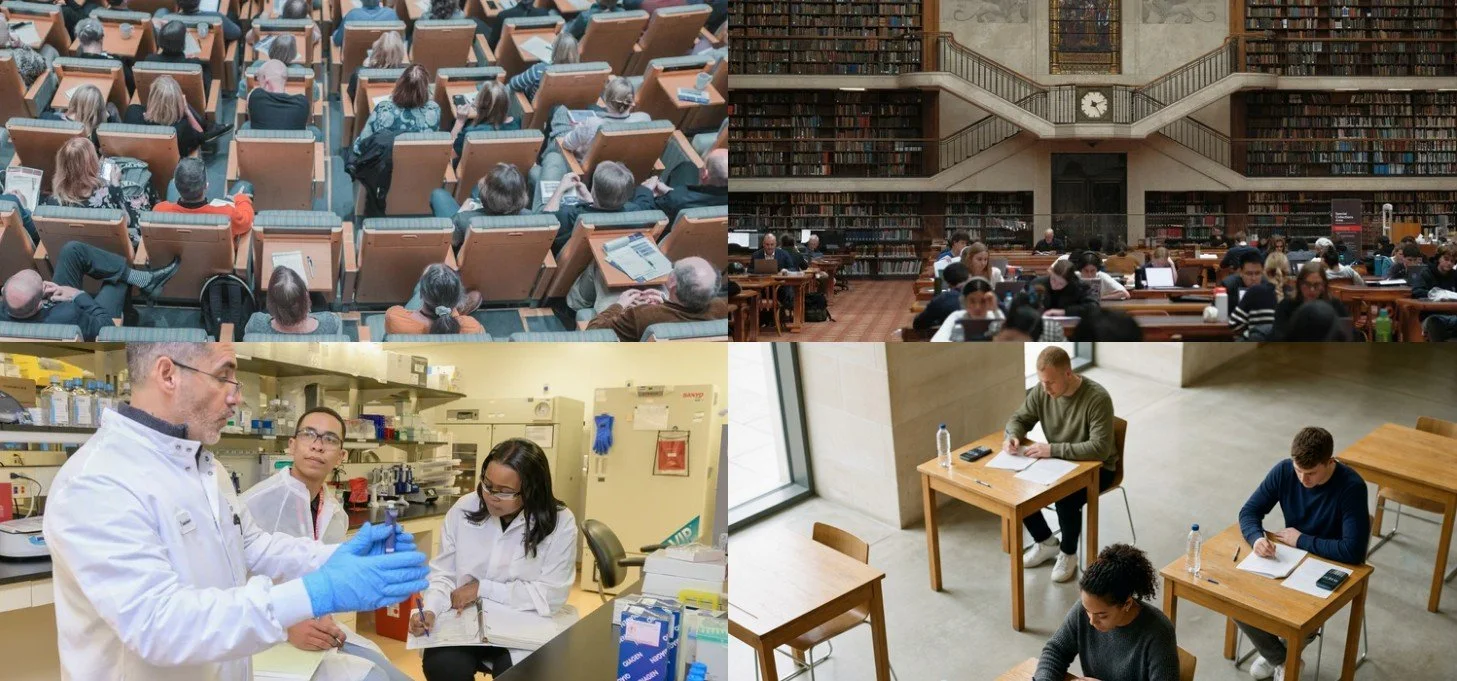
Support teams are responding to rising demand, increasingly varied needs, and growing expectations with limited time and resources. Digital processes can help services work more efficiently, but not at the expense of quality, accessibility, or professional judgement. The challenge is to increase capacity in ways that address immediate pressures while remaining adaptable to future needs.
More students are declaring disabilities
The number and proportion of students declaring a disability have increased substantially over the past decade, adding to potential demand for support. Disclosure remains much lower among international students, suggesting that recorded figures may still understate the full level of need.
More varied and overlapping needs
Recorded diagnoses of ADHD and autism have risen substantially, particularly among young people. As neurodevelopmental and other conditions frequently overlap, support teams increasingly need to understand individual profiles that cannot be explained by a single diagnostic label.
Timely and consistent support matters
Disabled applicants actively consider the support available when choosing where to study, and more students are sharing their needs before enrollment. Coordinating timely and consistent adjustments across departments and teaching contexts can place further demands on already teams that are already stretched.
Resources are under sustained pressure
Financial pressures are leading to difficult decisions about staffing, services, and investment. Within disability support, resourcing constraints can reduce team capacity and make some forms of support harder to secure. Making the best use of available staff time and expertise is increasingly important.
High caseloads strain specialist time
Disability teams support substantial student populations, with some reporting ratios of more than 750 disabled students per adviser. Support planning, documentation, coordination, and liaison all compete for limited specialist time, reducing the capacity available for detailed individual exploration.
Needs may emerge before formal evidence
Support needs may become apparent before a student has engaged with formal processes. Institutions can need to consider reasonable adjustments before a diagnosis, medical evidence, or full assessment is available. Clear routes for recognising and responding to emerging needs are essential.
These pressures do not reflect a lack of commitment. Existing processes are being asked to support more students, respond to more varied needs, and act earlier than they were designed to, including when students do not yet recognise or cannot clearly articulate the barriers they face. Meeting that challenge requires new ways to identify needs earlier, gather consistent information, and translate it into timely action without adding to specialist workloads.

A new way to extend institutional capacity
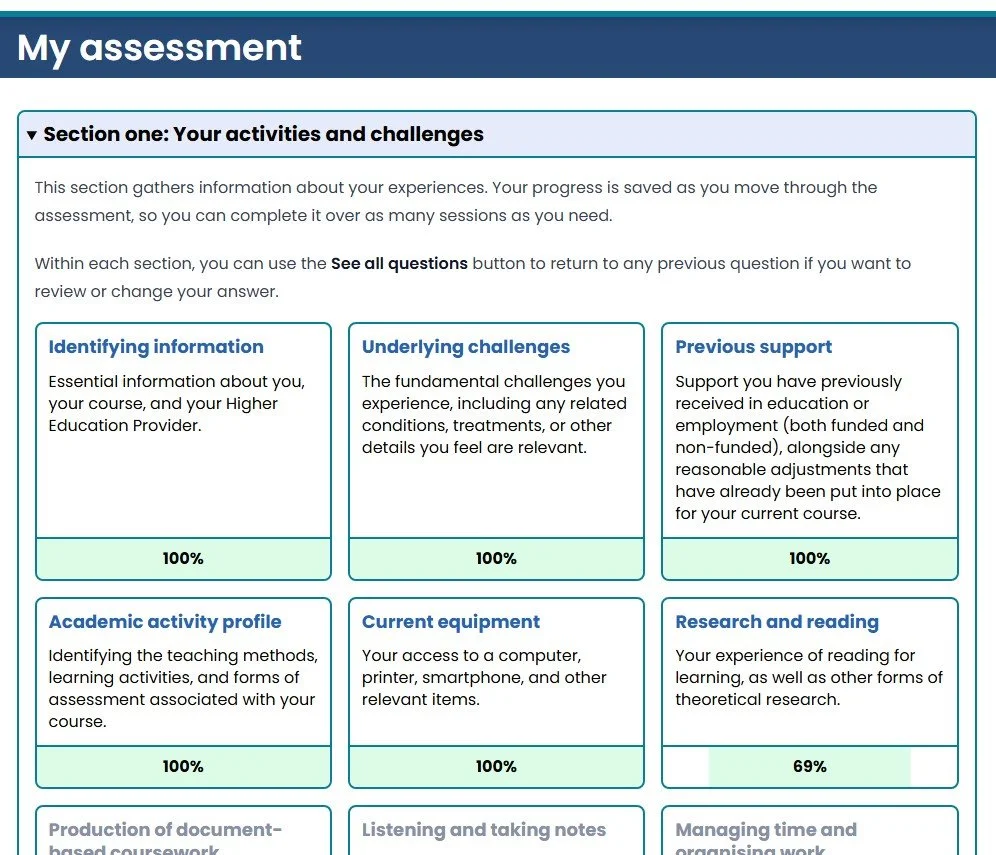
The UDISAS platform is a structured digital framework for gathering detailed information, applying defined decision rules, and producing clear written records.
Routine support procedures can be handled consistently at scale, preserving professional time for circumstances that require individual exploration or judgement.
Three core mechanics
Assessment Framework: form a comprehensive picture
Adaptive question sequences
Detailed exploration of activities, barriers, and circumstances
Graduated responses rather than simple yes-or-no declarations
No requirement for users to begin with a diagnostic label
Information that can be reused across related processes
Recommendation Engine: connect information to outcomes
Defined computational relationships between responses and outcomes
Consistent application of decision rules
Configurable outcome catalogues
Institutional control over which forms of support can be considered
Professional review where rules alone are insufficient
Report Generation: produce an immediate written record
Structured information is translated into clear written documentation
Records are generated immediately
Retention of reasoning connecting information and outcomes
Documents can support subsequent conversations and decisions
Repeated manual drafting can be reduced
Together, these capabilities can help institutions identify needs earlier, handle growing and increasingly varied demand more consistently, reduce repetitive administrative work, and concentrate specialist time where professional judgement adds the greatest value.
One platform, multiple configurations
UDISAS Higher Education is the first live product edition built on the UDISAS platform. It applies the platform’s Assessment Framework, Recommendation Engine, and report-generation capabilities to a defined pathway principally intended for students choosing to explore and self-fund their own support.
The underlying platform is broader than any single edition. Its questions, decision rules, available outcomes, review thresholds, and resulting documentation can be configured around different populations, policies, funding arrangements, and institutional objectives.
Additional product editions are being developed and scoped around other funded and institutionally managed support pathways.
A consistent platform foundation
Adaptive information gathering
Computational Recommendation Engine
Defined relationships between inputs and outcomes
Immediate generation of written records
Routes for professional review
Platform Management capabilities
A pathway configured for its context
Population and eligibility context
Questions and assessment pathways
Available strategies, technologies, and adjustments
Policy, evidence, and funding boundaries
Decision thresholds and review triggers
Form and content of resulting documentation
Product pathway configurations
Who and what the pathway assesses
A pathway can be designed around a particular student population, purpose, and decision context. Question sequences can include or exclude relevant areas, while evidence requirements can reflect the decisions the pathway is intended to support.
Which outcomes are presented for consideration
The available outcomes can be limited to those appropriate for the deployment, such as approved reasonable adjustments, institutionally licensed technology, free resources, or support available through a particular funding route.
UDISAS Higher Education single user licence Illustrative institutional configuration Student begins independently Institution provides or initiates access Broad exploration of study difficulties Questions aligned with a defined institutional process Relevant support strategies and assistive technologies Only approved adjustments, existing resources, or permitted technologies Student considers and ordinarily funds selected outcomes Outcomes governed by institutional policy and funding Personalised needs assessment report Institutionally defined support record or adjustment document Professional input for exceptions Review triggered according to agreed institutional rules
How decisions are made and recorded
Defined thresholds can determine which outcomes are produced automatically and which circumstances require professional consideration. The resulting documentation can then be structured around the records, decisions, and subsequent actions required for that pathway.
Illustrative comparison
UDISAS Higher Education single user licence
Student begins independently
Broad exploration of study difficulties
Relevant support strategies and assistive technologies
Student considers and ordinarily funds selected outcomes
Personalised needs assessment report
Professional input for exceptions
Illustrative institutional configuration
Institution provides or initiates access
Questions aligned with a defined institutional process
Only approved adjustments, existing resources, or permitted technologies
Outcomes governed by institutional policy and funding
Institutionally defined support record or adjustment document
Review triggered according to agreed institutional rules
Although configured for distinct contexts, each product edition remains internally consistent. Each pathway requires defined questions, documented relationships between information and outcomes, clear decision boundaries, and an agreed role for professional review.
This approach allows us to flexibly apply the same rigorous assessment model to a wide variety of different circumstances.
Curious about how the UDISAS platform could increase capacity within your institution?
No-cost trial
We can provide five free trial licences so that your institution can directly test our UDISAS Higher Education product edition.
Contact us
If you would like to know more, we would welcome the opportunity to discuss how the UDISAS platform can benefit your institution.
Learn more
Not ready to take the next step? Read more about the vision and mission of the company and the team of experts behind it.