Are Labels Actually Helpful?
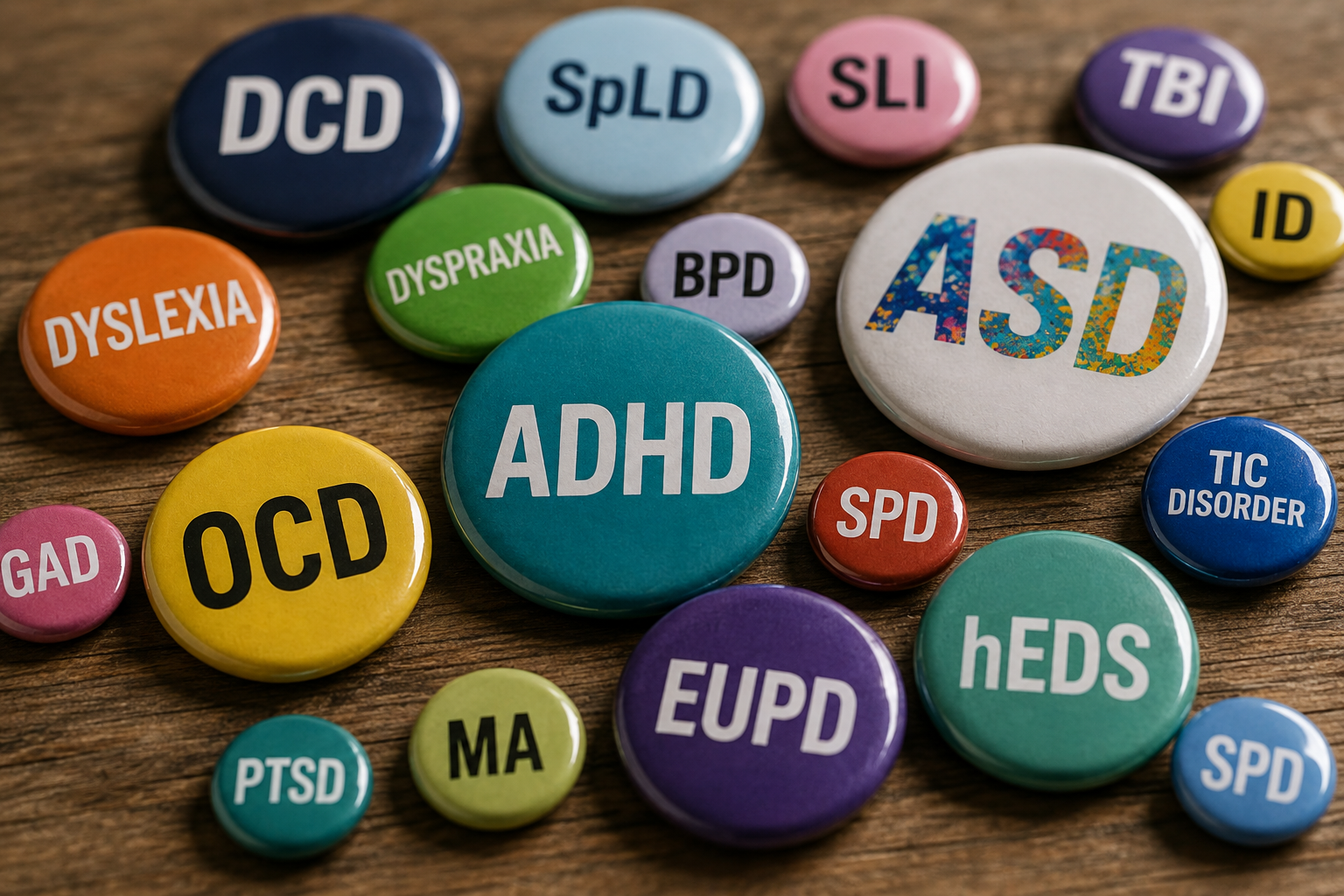
Human beings like naming and categorising things. We like certainty, structure, and simple explanations because they help us navigate the complexity of existence. We naturally gravitate toward binaries because binaries are easy to understand. Things are either on or off, open or closed, yes or no. Real life, however, is rarely that simple.
Most aspects of human experience exist somewhere within a spectrum between extremes. Life tends to be shades of grey rather than black and white. Yet despite this, society often relies on rigid labels and classifications to organise people, determine eligibility, and structure support systems. Nowhere is this more apparent than in discussions surrounding disability and neurodiversity.
Terms such as "neurodivergent", "neurotypical", "disabled", and "non-disabled" are now widely used across education, employment, healthcare, and public discourse. While they originate from different traditions and frameworks, they are often used in ways that align with the social model of disability, which emphasises the role of societal barriers in producing disabling outcomes.
In some contexts these labels are useful, or even necessary. In others, they can become crude oversimplifications that obscure more than they clarify.
Why Binary Classifications Exist
There are practical reasons why binary systems emerge.
Large organisations, governments, and funding bodies need mechanisms for determining who qualifies for support and who does not. Administrative systems are far easier to manage when eligibility can be reduced to a relatively simple yes-or-no decision.
In the UK, this can be seen across disability support schemes such as Disabled Students' Allowance (DSA), Access to Work, Personal Independence Payment (PIP), and Education, Health and Care Plans (EHCPs). In each case, there is ultimately a gatekeeping process: you either qualify or you do not.
The criteria differ between schemes, but the underlying logic remains the same. A person is classified as meeting the threshold for support, or they are not.
That binary approach is understandable from an administrative perspective. Public funding is finite, and governments require systems that can be applied consistently and at scale.
The problem is that human experience does not naturally conform to neat binary categories.
The Problem with Labels
Take physical disability as an example. A person with severe degenerative disc disease is highly likely to experience a significant physical impairment. That is relatively unambiguous.
But what about a person with chronic back pain caused by repetitive strain and poor posture? At what exact point does "a bit of back pain" become a disability?
Vision is another good example. A person who is legally blind is clearly visually impaired. But what about a person who is significantly short-sighted and unable to safely drive without glasses? In practical terms, remove their corrective lenses and their ability to function changes dramatically.
Of course, disability has a legal definition in the Equality Act 2010, but in practical terms difficulty exists on a spectrum.
Similar variation can be seen in neurodivergent experiences. Two individuals with the same diagnosis – or non-diagnosis – may have entirely different practical experiences.
One autistic person may experience substantial day-to-day barriers relating to communication and social interaction. Another may experience similar traits but work and live in circumstances where those difficulties have far less practical impact.
Equally, two people without any formal diagnosis may still experience very real challenges with concentration, literacy, organisation, memory, sensory processing, or communication.
Human beings rarely fit neatly into the categories we create for them. The reality of people's lives is far more varied, and the boundaries are much blurrier than the labels suggest.
Neurodivergence Is Not a Monolith
One of the problems with terms like "neurodivergent" and "neurotypical" is that they encourage people to think in broad camps rather than individual experiences. However, neurodivergent people are not a monolith.
A person with a dyslexia diagnosis characterised primarily by difficulties with processing speed and working memory may have a considerably different educational experience from a person whose dyslexia heavily impacts reading accuracy and written comprehension.
Similarly, ADHD, autism, OCD, bipolar, auditory processing disorder, and other neurodevelopmental or psychological conditions all present differently across individuals, as people sharing the same diagnosis can have vastly different experiences. There is even ongoing debate about what “neurodivergence” encompasses, including which conditions should or should not fall under the label.
At the same time, "neurotypical" people are not a monolith either. Some people may narrowly miss the threshold for diagnosis while still experiencing significant practical difficulties. Others may have personality traits, learning styles, or cognitive tendencies that affect how they work and learn without ever being formally classified as neurodivergent.
The line itself is less clear-cut than it might appear.
Diagnostic systems are ultimately based on thresholds. A person displays enough markers to receive a label, or they do not. In many cases, a person could sit on either side of that threshold depending on timing, context, stress levels, coping strategies, and how their difficulties present during the assessment process.
That does not make the underlying challenges imaginary. It simply highlights how imperfect binary classification systems can be when applied to complex human beings.
When Labels Become Counterproductive
Labels can sometimes help people understand themselves and access support, but they can also encourage assumptions.
Once a person is categorised as neurodivergent, people often begin attaching preconceived ideas to what that means. Equally, a person labelled neurotypical may be presumed to have no meaningful difficulties at all.
That oversimplification creates barriers to empathy and understanding. It can encourage division and foster tribal attitudes, with people organising themselves into opposing groups and making assumptions about one another based on labels rather than individual experiences.
Instead of practical realities, discussions can become focused on identity categories. At worst, when people begin thinking in terms of “us and them”, it is very easy for "the others" to be reduced to a simplified caricature that bears little resemblance to the complexity of real people.
In reality, most people exist somewhere within a complex mixture of strengths, weaknesses, preferences, coping strategies, and environmental pressures.
What matters most is not the label itself but whether or not a person is struggling and whether support would help.
Focusing on Difficulties Instead of Labels
This is one of the core principles behind the design of UDISAS.
The system was originally built upon extensive experience conducting disability needs assessments across higher education and employment support contexts.
During development, hundreds of disabilities, neurodivergent conditions, and support scenarios were analysed and mapped, with detailed profiles created for each.
One of the most important conclusions that emerged from this work was that diagnostic labels alone are often a poor way of understanding support needs.
Two people with the same diagnosis can require entirely different support strategies. Equally, two people with no diagnosis whatsoever may still benefit enormously from practical support adjustments.
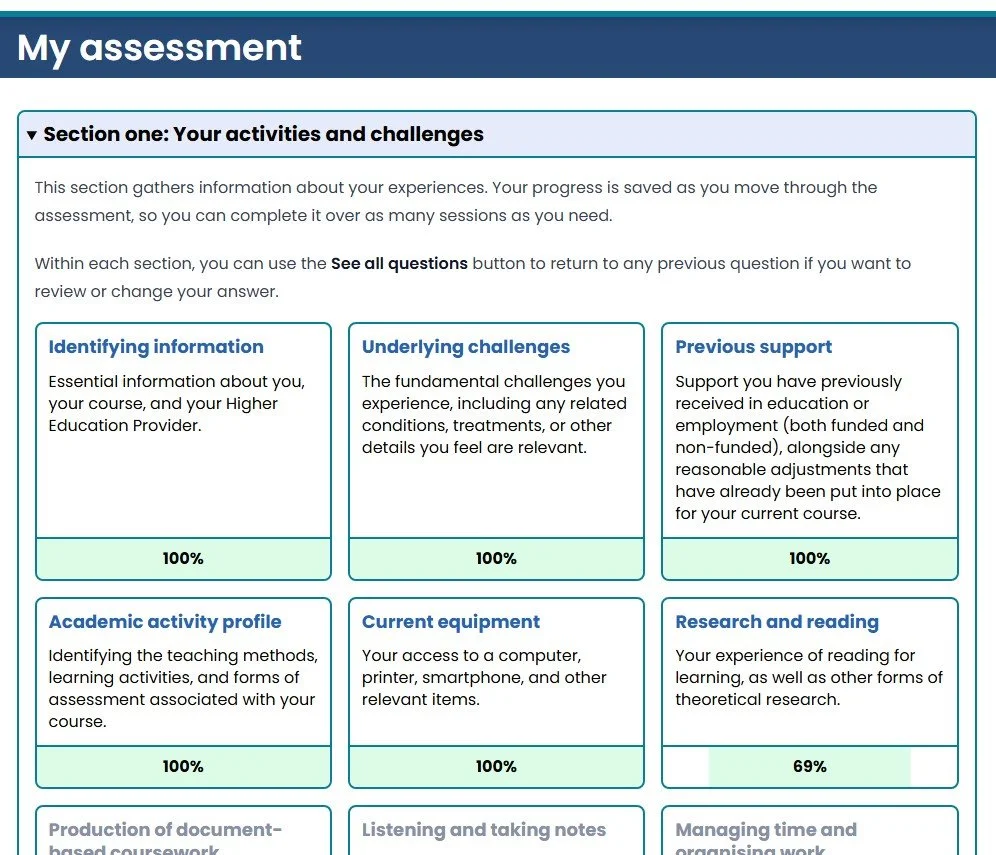
As a result, UDISAS was designed to focus primarily on identifying what the platform refers to as "underlying challenges", rather than requiring users to begin with a diagnostic label.
The platform allows users to skip diagnostic identification entirely if needed. Instead, the assessment process explores practical difficulties directly, such as challenges with literacy, attention, organisation, pain, fatigue, mobility, or social awareness and understanding.
Once those underlying challenges are identified, the system explores how they affect the individual's real-world activities within education or employment contexts.
This approach allows support needs to be identified regardless of whether the person has received a diagnosis, has disclosed a diagnosis, or even fully understands the cause of their difficulties themselves.
This reflects the reality that many people experience genuine barriers and challenges without necessarily identifying with a particular diagnostic or disability label.
The Most Important Binary
Ultimately, there is one binary that matters more than all the others: would this person benefit from support, or would they not?
That is the question that has the greatest practical relevance for employers, education providers, and organisations genuinely interested in helping people succeed.
If a person is struggling with any practical challenge that meaningfully affects their ability to perform, does it really matter whether that difficulty originates from a recognised disability, a neurodivergent condition, educational disadvantage, language barriers, life circumstances, or simply individual variation?
The difficulty still exists, and the impact is still real.
If tailored support could improve that person's wellbeing, learning experience, confidence, productivity, or professional performance, then there is value in addressing the difficulty regardless of which label does or does not apply. When barriers are reduced, people are better able to participate, contribute, and succeed, benefiting both themselves and the organisations they are part of.
That is the philosophy behind UDISAS.
Rather than treating support as something reserved exclusively for people who fit neatly into administrative categories, the platform is designed to identify and respond to genuine practical need.
Because human experience is not binary, and support systems work best when they recognise that.