Why we built UDISAS
I have worked as a disability needs assessor for the past 16 years. During that time, I have conducted assessments across higher education and employment support schemes, working with individuals with a vast range of disabilities, health conditions, and neurodivergent profiles.
Like most assessors, I entered the profession because I wanted to help people. In many cases, the process worked well. People received support that genuinely improved their ability to study, work, communicate, organise themselves, while reducing barriers that had previously limited their opportunities.
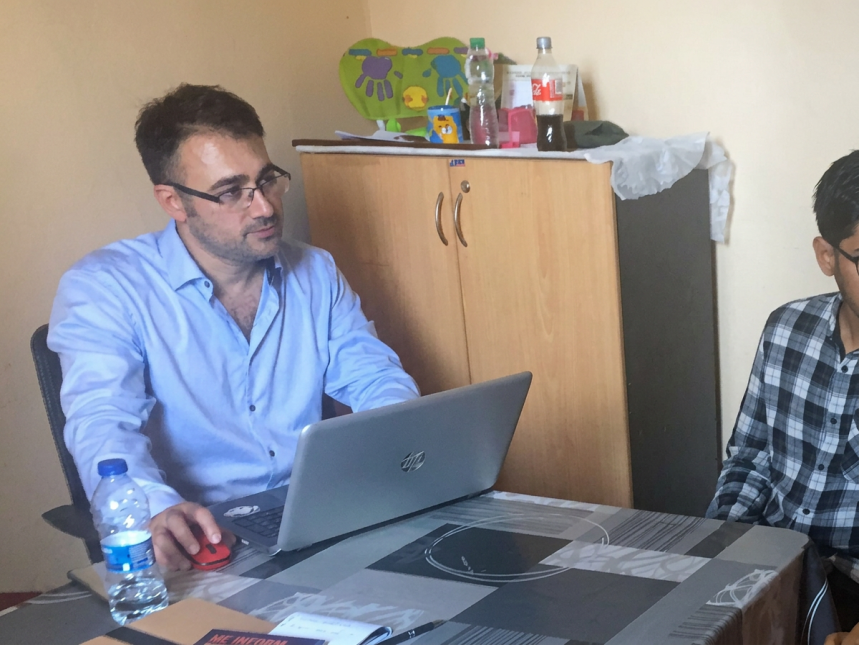
Robin Hodges conducting an assessment in Mauritius in 2019, during a project funded by Commonwealth of Learning.
Yet over time, I began to notice a pattern. The challenges faced by disabled people are often not confined to the impacts of their difficulties on their study or work activities. In many cases, disabled people are failed by the very systems designed to identify, administer, and deliver the support they need.
The more assessments I conducted, the more I became convinced that many of these problems were not individual failures. They were structural problems. Structural problems require structural solutions.
The Human Assessment Model Works - Up to a Point
A traditional human needs assessment is fundamentally conversational. An assessor meets with an individual, explores their difficulties, discusses potential support measures, and produces recommendations designed to reduce barriers.
There is a great deal of value in this process. Experienced assessors develop substantial expertise. They learn how to identify patterns, explore difficulties, ask the right questions, and guide individuals through complex support systems.
The individual is given an opportunity to discuss challenges that they may never previously have explored in a structured way. For many people, it is the first time they have been asked to reflect in detail on how their difficulties affect their daily lives, difficulties that can acquire significant emotional weight over time.
However, the model also has several limitations, many of which are rooted in time and space.
Every assessment must be scheduled around the availability of the assessor and the disabled person. Every assessment takes place within a limited period of time. Every assessment relies on one person explaining information clearly and another person understanding and retaining it.
Furthermore, the one-to-one nature of the assessment means that the process is fundamentally difficult to observe. While reports provide evidence of the outcome, they offer only limited visibility of the assessment process itself. This makes it harder to support assessors in their work, promote consistency, evaluate quality, and identify emerging best practice within the profession.
Much of the data generated through assessment is also fragmented across individual reports and organisations, making it difficult to analyse trends at scale. Even after support has been implemented, there are few consistent mechanisms for evaluating its long-term impact.
No matter how skilled the assessor, those constraints never disappear.
Over thousands of assessments, I repeatedly saw the same issues emerge. People struggled to recall important details during appointments and articulate difficulties that they had spent years normalising. People were introduced to an ever-growing range of support options and expected to make decisions about them within a relatively short period of time.
Most people left assessments with recommendations that were entirely appropriate based on the information available at the time, but which they had only briefly considered and rarely had the opportunity to trial in a real-world setting. In effect, individuals were typically required to make binary decisions about support measures they had never used, based largely on descriptions rather than experience.
On balance, the assessment and support process was typically effective overall, but it was rarely ideal.
The People In Most Need Are Often the Hardest to Reach
One of the most striking observations from years of assessment work was how many people did not recognise their own support needs.
Some were not aware that their circumstances could be classified as a disability. Others did not realise that their difficulties were unusual, believing instead that everyone experienced the same challenges that they did.
Some people recognised their difficulties, but were either unaware of the availability of support or did not believe it would help. Many were reluctant to disclose personal information because they feared judgement, stigma, or negative consequences.
This was particularly common among individuals with hidden disabilities and neurodivergent conditions.
In reality, people rarely wake up one morning and decide to seek a needs assessment. Support is often only accessed after years of struggle, frustration, and compensatory effort, with the processes of disclosure, eligibility, and application often proving among the greatest challenges of all.
By that point, opportunities may already have been lost. Academic performance may have suffered, careers may have stalled, and confidence may have been considerably damaged.
The challenge was not simply identifying appropriate support for those who were already seeking help. There was a lack of a clear and accessible pathway that enabled people to recognise their difficulties, understand their options, and engage with support at an earlier stage.

The Administrative Burden Was Growing
At the same time, support systems themselves were becoming increasingly complex. The range of available assistive technology solutions expanded dramatically, while funding systems became more complicated and documentation requirements increased. Assessors, organisations, and disabled individuals all found themselves managing growing volumes of information, putting increasing strain on an already time-limited assessment process.
Amidst all of this change and reform, the framework of the assessment itself remained largely unchanged, aside from the post-Covid shift towards remote delivery. Information was still typically delivered through reports, letters, emails, attachments, and disconnected systems.
Important guidance was frequently buried within lengthy documents or, at best, relayed by word of mouth during an assessment. Support recommendations were often separated from the information needed to understand, implement, or review them.
Beyond the limitations of the assessment model itself, a growing challenge lay in ensuring that support information remained accessible, understandable, and actionable long after an assessment had ended.
Fundamentally, the assessment model emerged in an era of greater simplicity, when there were fewer support options, less complex policy frameworks, and less need for ongoing review. As support ecosystems became more sophisticated, the amount of information surrounding assessment grew exponentially, while the mechanisms for managing that information barely changed. The result was a process that increasingly relied on individuals navigating large volumes of disconnected information at precisely the point when they were seeking clarity and support.
Technology Was Not Solving the Right Problem
More recently, as technology advanced, it has been claimed that artificial intelligence would eventually solve these challenges. I was never convinced.
Needs assessment is not a simple process of generating plausible answers on demand. It is a structured professional activity that requires a consistent, evidence-based and auditable framework for identifying need, particularly where the outcomes directly influence the allocation of finite and costly support resources. If the process is not rigorous and transparent, it is not fit for purpose.
Large language models can generate suggestions rapidly and fluently, but speed of output is not equivalent to validity of judgement. They do not replicate the accumulated professional expertise developed through thousands of real-world assessments, nor do they inherently provide the transparency, traceability, and accountability required when decisions carry educational, financial, and practical consequences.
The limitation is not simply that artificial intelligence is imperfect, but that it operates at the wrong level of abstraction for this task. The modernisation of needs assessment is not primarily a language problem; it is a structured reasoning and evidential validation problem.
This does not mean that expertise cannot be supported or enhanced. Rather, it suggests a different direction: human intelligence should not be replaced or simulated, but augmented by systems that capture professional expertise, codify it, and make it consistently and transparently accessible within a governed framework.
Building a Better Assessment Model
UDISAS was built around a simple question: if needs assessment were designed from first principles today, what would it look like? Not a digital replica of a traditional assessment, a chatbot, or an online form, but a fundamentally different approach to identifying and understanding support needs.
The result is a platform built upon knowledge derived from thousands of needs assessments and years of professional practice.
Instead of requiring individuals to fit within a fixed appointment slot, the platform allows them to engage with the assessment process at their own pace.
Instead of requiring the individual to begin with diagnostic labels, it focuses primarily on the practical difficulties that affect day-to-day work and participation.
Instead of presenting support options once during a conversation, it allows users to explore information, revisit guidance, compare solutions, and make informed decisions over time.
Instead of relying upon assessment outcomes that emerge from private conversations, it provides a transparent and auditable framework in which needs, recommendations, and decisions can be clearly understood, justified, and analysed at scale.
Most significantly, it creates the time and space for reflection. The individual can consider their experiences, explore potential solutions, and develop a fuller understanding of their own support needs than is often possible within the constraints of the traditional assessment model.
Preserving Human Expertise Where It Matters Most
At this point, it would be reasonable to assume that the objective is to remove experienced professionals from the assessment process. That was never the goal.
Professional expertise remains central to effective needs assessment. Expert assessors are not unnecessary, but their time and expertise are finite resources. Not every assessment requires extensive one-to-one intervention, and applying the same level of professional input to every case is neither efficient nor always necessary.
Many support needs are relatively well understood and can be identified through a structured and evidence-based assessment framework. Others are unusual, complex, or highly context-specific. These are the situations where experienced professionals provide the greatest value, drawing upon judgement, insight, and experience that cannot easily be standardised.
For that reason, UDISAS was designed as a hybrid model.
The platform supports the identification and exploration of common support needs through a flexible digital framework, enabling many individuals to identify appropriate support options independently and at their own pace, without any need for human intervention.
Where more complex circumstances arise, professional expertise remains available. Rather than attempting to replace expert assessors, the system enables their knowledge and skills to be focused where they can have the greatest impact.
In this way, technology does not replace professional judgement. It helps ensure that professional judgement is applied where it is most needed.
More Than a Needs Assessment Platform
At its heart, UDISAS is not solely about disability. It is about understanding and removing barriers that prevent people from performing to their best.
Many of those barriers arise from disability or neurodiversity. Others stem from educational backgrounds, language differences, personal circumstances, or individual characteristics. Few people excel equally in every area of life; most possess a unique combination of strengths and weaknesses.
Regardless of the source of the barrier, the underlying principle remains the same. People are more likely to succeed when unnecessary obstacles are removed and appropriate support is available.`
Throughout my career, I have met talented students who questioned their abilities because they could not understand why certain tasks seemed harder for them than for their peers.
I have met employees who developed complex coping strategies to manage challenges that could often have been reduced through relatively simple adjustments.
I have seen support arrive later than it should because the pathway to obtaining it was unnecessarily difficult to navigate.
UDISAS was created to address those problems. Not by replacing professional expertise or judgement, but by making the assessment process more accessible, more consistent, more transparent, and more effective.
The platform represents what I believe is the next stage in the evolution of needs assessment: a system that combines human expertise, structured knowledge, and digital accessibility to help people understand their difficulties, identify appropriate support, and realise their potential.
Ultimately, a traditional needs assessment is a conversation constrained by a race against time. For the assessor, there is constant pressure to gather and deliver information while simultaneously capturing a record sufficient to produce an accurate report afterwards. For the disabled individual, there is equal pressure to process information, make decisions, and resolve uncertainties before the appointment ends.
By removing these time constraints and providing easy access to information that can be revisited when needed, our goal was to create the conditions for more informed and considered decision-making. Rather than simply making assessment more efficient, we aim to enable individuals to better understand their options and make decisions with confidence. In turn, this increases the likelihood that support choices are genuinely effective in practice, delivering better outcomes for disabled people and better value from the resources invested in supporting them.